

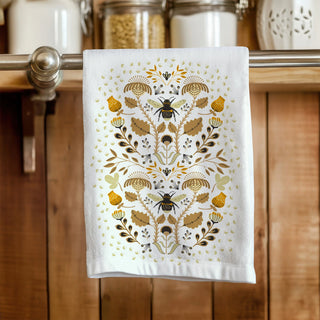

For countless generations, textile designers have been creating patterns inspired by nature, drawing (no pun intended) inspiration from plants, flowers, insects and more. Designers working their craft in all forms of media, from ancient civilizations to the present, have found their muse in the beauty and variety of the outdoors. Art helps textile designers communicate their love of nature and connect them to something intimately fundamental to their lives.
Nature and Our Connection to It
The primary reason that I garden is to renew my connection to nature—in a fairly safe way. I've often said, sometimes to convince myself, that Nature is a beautiful thing. But, as my dear mom, who was an excellent gardener and artist used to say, “Nature is hostile.” Yes, it’s dangerous, threatening and it makes loud buzzing noises. It flaps around our heads and ears, it has stabby thorns, biting jaws, rash-inducing juices, and large, pointy fangs—all those animal and insect accessories that put your face and organs at risk. My hiking friends will say, “Oh, come on, don't you want to see what's behind that grove of trees?
"Bears and cougars," I say. "Hungry diners come to dine at Chez Me."
I digressed.
Our connection to nature is universally shared whether you spend a lot of time indoors or call the outdoors your first home. Textile artists inspired by nature find this subject to be an endless source of inspiration.
Why Does Nature Inspire Us to Create Art?
I believe, in part, that the roots of our connection to nature stem from an uncomfortable relationship with an increasingly mechanized, urbanized and industrialized society. All of these things (advancements!) tend to distance us from nature. It makes me sad when I see people taking a walk, their eyes glued to their phones, ignoring the birds chirping, leaves rustling in the breeze, colorful flowers, and ... their dogs.
Nature Reminds us of Beauty in the World
The visual display that nature offers inspires artists to record or reinterpret what they see around them—instilling in them a desire to capture nature's beauty for eternity.
Nature Sparks Our Imagination
Nature stimulates creative thinking and encourages artists to discover new ways of interpreting what they see. There are infinite ways to depict a flower, don't you think?
Nature's Objects Act as Metaphors
Metaphors are, in a way, symbols that stand for something else—a feeling, a mood, a political belief and much more. Artists convey their emotions through using nature's motifs as metaphors. It can be a way to express difficult or pleasant ideas.
A Connection to Something Greater Than Themselves
If you're spiritual in any sense of the word, Nature provides us with a glimpse of something greater than ourselves.
No matter how allergic you are to everything botanical, nature still calls you to join the fun.
Famous Textile Designers: Lucienne Day and Her Reimagining of Nature
Lucienne Day was one of the world's foremost post-war British fabric designers, creating textiles that decorated almost every home across the country throughout the 1950s and beyond. She brought nature into the home in a uniquely modern way for the time in which she lived.

Day is best known for her textile pattern, titled Calyx, a stylized floral design that received the prestigious gold medal at the IX Milan Triennale in 1951. It was rated the best textile on the American market by the American Institute of Decorators in 1952.
Calyx from Wikipedia

Day was influenced by modern artists such as Paul Klee, Joan Miró and Alexander Calder, whose mobiles were an inspiration for Calyx.
A Sampling of Other Works by Day
Parkland, Heal’s Fabrics, Lucienne Day, 1974

Provence, wallpaper, Lucienne Day, 1951

Fluellin, furnishing fabric, Lucienne Day, 1950

I love Lucienne Day fabric because it's playful and lively even though her color palettes are spare and often quite subtle. And there's an underlying symmetry and organization to her work that I find appealing. Nature inspired home decor doesn't have to rely solely on photographs of flowers and other plants. And I mean no insult here, because my home is decorated with some lovely photos of landscapes.
Finding Inspiration from Your Environment
Whenever I create a botanical pattern, I acknowledge that I'm influenced by the many famous textile designers who left a legacy that all artists should be grateful for. There exist dozens of types of textile patterns that surface pattern designers use in their work and a vast array of motifs. Designers include motifs such as animals, birds, florals, geometrics and other shapes—the list is endless. Personally, I get the most enjoyment out of creating a botanical pattern, which can incorporate plants from my garden or from the gardens of my friends. When I started as a surface pattern designer, I found inspiration on my hikes in the foothills here and photographed many native plants that became motifs for my early designs.
For sure, a nature inspired home brings me joy and helps create a path from the outdoor to the indoor me—without all those bugs.
For more information about Lucienne Day, check out this article:
The enduring appeal of Lucienne Day’s designs
Main Image: My Carefree Flower Garden Cotton Linen Pillow Cover